
Active filters Topic: Artemis
Clear all
1 Apr 2026, 00:00 GMT By KSC 6 frames

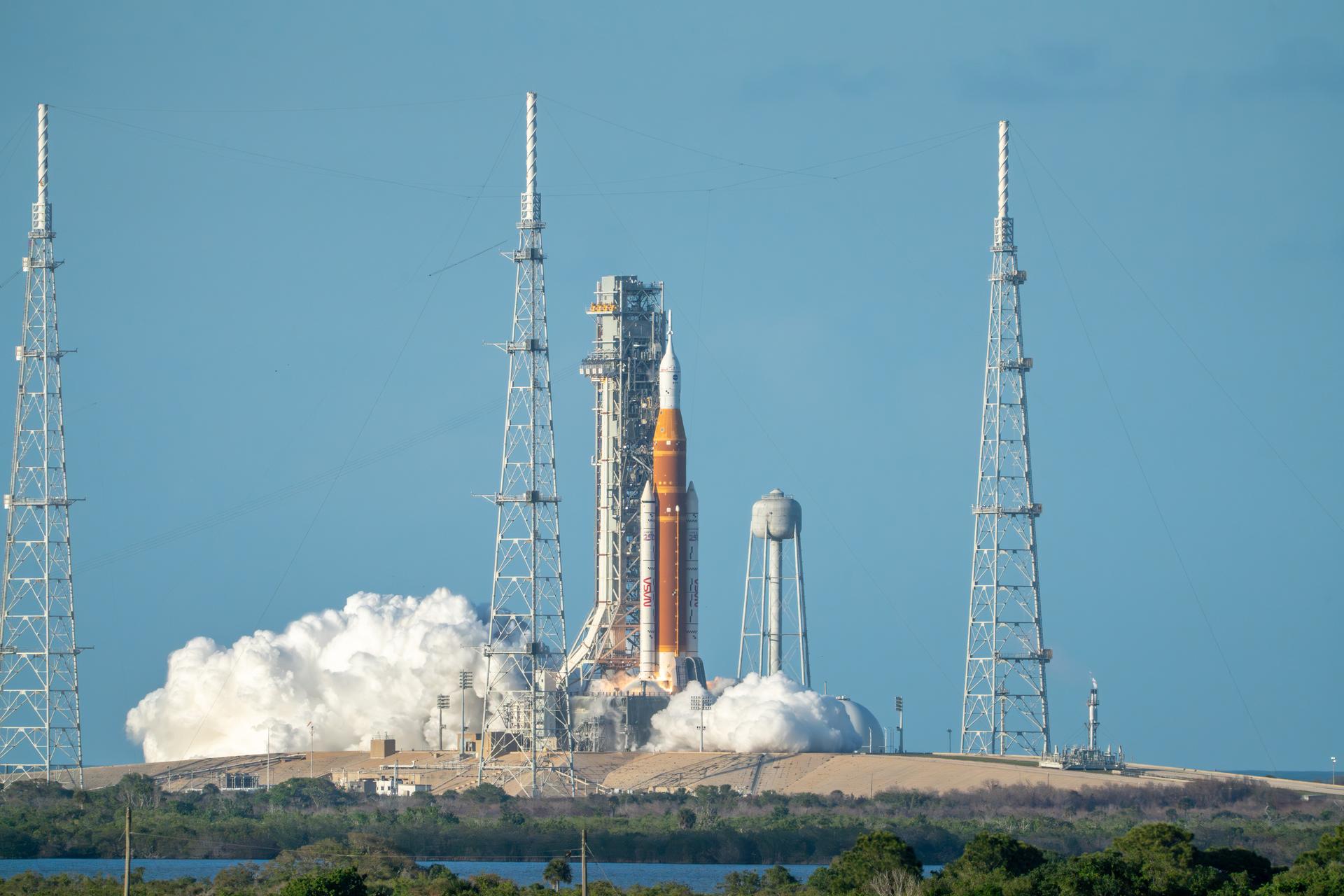
Four astronauts aboard NASA’s Orion spacecraft atop the SLS (Space Launch System) rocket launch on the agency’s Artemis II test flight, Wednesday, April 1 from Launch Complex 39B at NASA’s Kennedy Space Center in Florida. Artemis II lifted off at 6:35 p.m. ET. Artemis II is the first crewed mission of the agency’s Artemis campaign. The mission will send NASA astronauts Reid Wiseman, Victor Glover, and Christina Koch and CSA (Canadian Space Agency) astronaut Jeremy Hanson on an approximately 10-day journey around the Moon and back to Earth.

Download item bundle
Sequence Artemis II Launch
17 Jan 2026, 00:00 GMT By MSFC

NASA’s crawler-transporter 2 carrying the agency’s Artemis II SLS (Space Launch System) rocket and Orion spacecraft, secured to the mobile launcher, begins the 4.2-mile journey toward Launch Complex 39B at NASA’s Kennedy Space Center in Florida on 01/17/2026. The Artemis II test flight will take Commander Reid Wiseman, Pilot Victor Glover, and Mission Specialist Christina Koch from NASA, and Mission Specialist Jeremy Hansen from the CSA (Canadian Space Agency), around the Moon and back to Earth no later than April 2026.

Download item bundle
Video
Credit: NASA/Brandon Hancock
14 Jan 2026, 00:00 GMT By HQ

The AVATAR (A Virtual Astronaut Tissue Analog Response) investigation will use organ-on-a-chip devices, or organ chips, to study the effects of deep space radiation and microgravity on human health. The chips will contain cells from Artemis II astronauts and fly side-by-side with crew on their approximately 10-day journey around the Moon. This research, combined with other studies on the health and performance of Artemis II astronauts, will give NASA insight into how to best protect astronauts as exploration expands to the surface of the Moon, Mars, and beyond. For more information: go.nasa.gov/4m5dGH9

Download item bundle
Video
Credit: NASA HQ
14 Jan 2026, 00:00 GMT By HQ

The AVATAR (A Virtual Astronaut Tissue Analog Response) investigation will use organ-on-a-chip devices, or organ chips, to study the effects of deep space radiation and microgravity on human health. The chips will contain cells from Artemis II astronauts and fly side-by-side with crew on their approximately 10-day journey around the Moon. This research, combined with other studies on the health and performance of Artemis II astronauts, will give NASA insight into how to best protect astronauts as exploration expands to the surface of the Moon, Mars, and beyond. For more information: go.nasa.gov/4m5dGH9

Download item bundle
Video
Credit: NASA HQ
18 Nov 2022, 00:00 GMT By HQ

Description: Recent Artemis I footage captured by rocket cameras during ascent aboard the Artemis I spacecraft. Footage includes live recordings of Artemis I’s Booster Separation, and Artemis I’s Booster Jettison.

Download item bundle
Video
Credit: NASA HQ
6 Nov 2021, 00:00 GMT By MSFC

NASA's Marshall Space Flight Center partnered with Downtown Huntsville Inc. to tell the Artemis story and highlight the contributions to the Mission. MSFC Center Director, Jody Singer and Huntsville Mayor, Tommy Battle kicked off the event.

Download item bundle
Video
Credit: Alex Russell
11 Dec 2020, 00:00 GMT By HQ

Through the Artemis program NASA and a coalition of international partners will return to the Moon to learn how to live on other worlds for the benefit of all. With Artemis missions NASA will send the first woman and the next man to the Moon in 2024 and about once per year thereafter. Through the efforts of humans and robots, we will explore more of the Moon than ever before; to lead a journey of discovery that benefits our planet with life changing science, to use the Moon and its resources as a technology testbed to go even farther and to learn how to establish and sustain a human presence far beyond Earth. Learn more: www.nasa.gov/ArtemisTeam

Download item bundle
Video
Credit: NASA HQ
9 Dec 2019, 00:00 GMT By HQ

Artemis Media Resource Material-Interview Soundbite material for NASA's Artemis Program. With the Artemis program, NASA will land the first woman and next man on the Moon by 2024, using innovative technologies to explore more of the lunar surface than ever before. We will collaborate with our commercial and international partners and establish sustainable exploration by 2028. Then, we will use what we learn on and around the Moon to take the next giant leap – sending astronauts to Mars.

Download item bundle
Video
Credit: NASA HQ
19 Jul 2019, 00:00 GMT By HQ

We Go: To the Moon and on to Mars. Our generation, the Artemis generation, will explore farther than we've ever gone before. The Artemis program will send the first woman and next man to walk on the surface of the Moon and build a sustainable base to prepare for missions to Mars and beyond.

Download item bundle
Video
Credit: NASA HQ