Our Artemis II Moon mission is complete! Space Launch System rocket launched crew into space Orion spacecraft provided a safe “home away from home” for astronauts Flew around the Moon, observed its far side, and conducted science New human spaceflight distance record Crew safely returned to Earth Inspired the WORLD We're just getting started: https://www.nasa.gov/mission/artemis-iii/
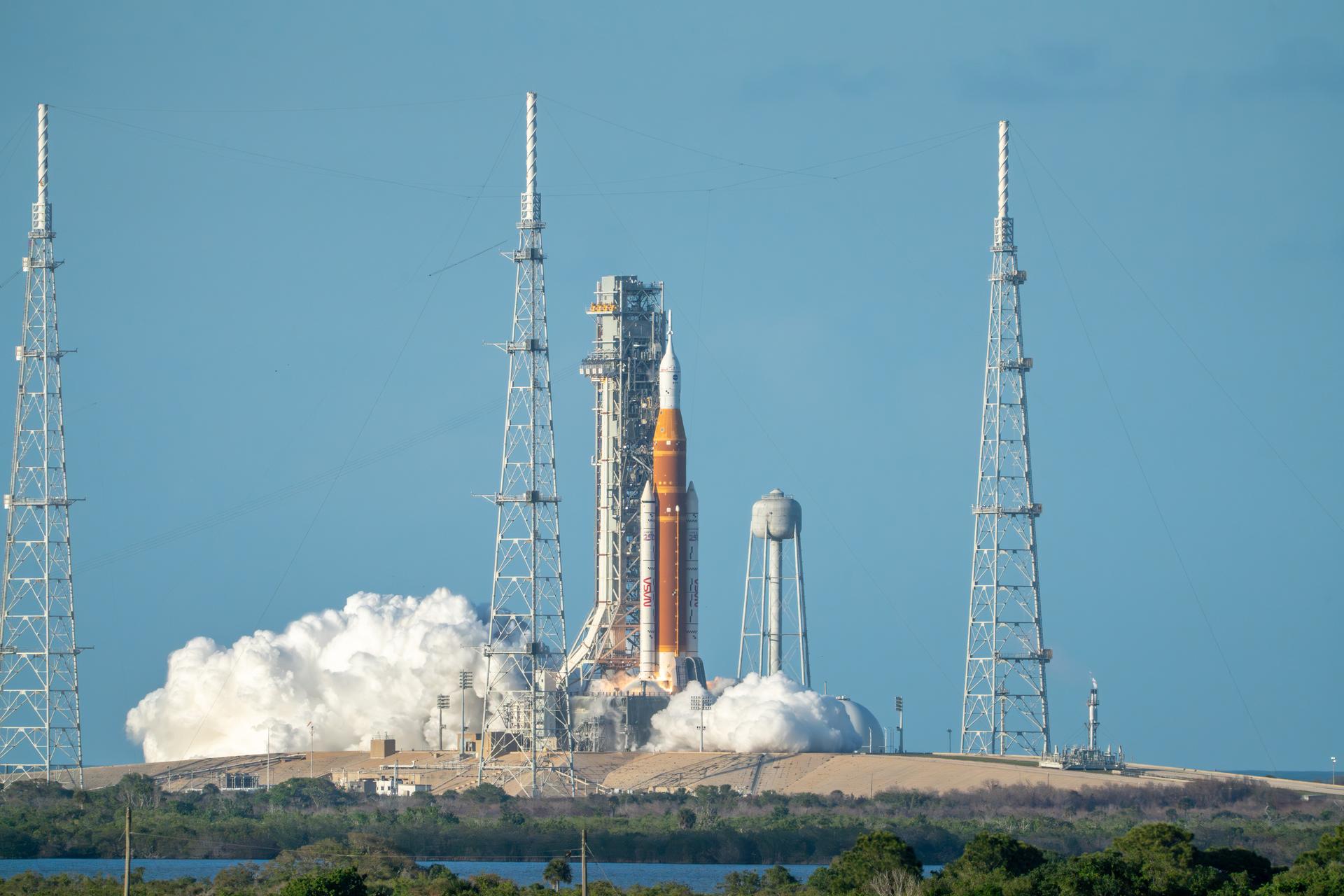
Four astronauts aboard NASA’s Orion spacecraft atop the SLS (Space Launch System) rocket launch on the agency’s Artemis II test flight, Wednesday, April 1 from Launch Complex 39B at NASA’s Kennedy Space Center in Florida. Artemis II lifted off at 6:35 p.m. ET. Artemis II is the first crewed mission of the agency’s Artemis campaign. The mission will send NASA astronauts Reid Wiseman, Victor Glover, and Christina Koch and CSA (Canadian Space Agency) astronaut Jeremy Hanson on an approximately 10-day journey around the Moon and back to Earth.
NASA’s crawler-transporter 2 carrying the agency’s Artemis II SLS (Space Launch System) rocket and Orion spacecraft, secured to the mobile launcher, begins the 4.2-mile journey toward Launch Complex 39B at NASA’s Kennedy Space Center in Florida on 01/17/2026. The Artemis II test flight will take Commander Reid Wiseman, Pilot Victor Glover, and Mission Specialist Christina Koch from NASA, and Mission Specialist Jeremy Hansen from the CSA (Canadian Space Agency), around the Moon and back to Earth no later than April 2026.
The AVATAR (A Virtual Astronaut Tissue Analog Response) investigation will use organ-on-a-chip devices, or organ chips, to study the effects of deep space radiation and microgravity on human health. The chips will contain cells from Artemis II astronauts and fly side-by-side with crew on their approximately 10-day journey around the Moon. This research, combined with other studies on the health and performance of Artemis II astronauts, will give NASA insight into how to best protect astronauts as exploration expands to the surface of the Moon, Mars, and beyond. For more information: go.nasa.gov/4m5dGH9
The AVATAR (A Virtual Astronaut Tissue Analog Response) investigation will use organ-on-a-chip devices, or organ chips, to study the effects of deep space radiation and microgravity on human health. The chips will contain cells from Artemis II astronauts and fly side-by-side with crew on their approximately 10-day journey around the Moon. This research, combined with other studies on the health and performance of Artemis II astronauts, will give NASA insight into how to best protect astronauts as exploration expands to the surface of the Moon, Mars, and beyond. For more information: go.nasa.gov/4m5dGH9
Description: Recent Artemis I footage captured by rocket cameras during ascent aboard the Artemis I spacecraft. Footage includes live recordings of Artemis I’s Booster Separation, and Artemis I’s Booster Jettison.
Seasons change even on Mars and NASA's fleet of explorers are helping scientists learn more about the effects on the Red Planet. NASA's Perseverance and Curiosity rovers provide daily weather reports by measuring conditions such as humidity, temperature, and wind speed on the surface. Orbiters including Odyssey, Mars Atmosphere and Volatile EvolutioN (MAVEN), and the Mars Reconnaissance Orbiter (MRO) survey the scope and scale of storms from above. Changing weather conditions can be challenging for the spacecraft. The Ingenuity Mars Helicopter recently increased its rotor speed from 2,537 rpm to 2,700 rpm to fly in a thinner summer atmosphere. Meanwhile, NASA’s InSight lander, which is studying Mars’ interior, recently measured one of the biggest, longest-lasting marsquakes the mission has ever detected. For more information on NASA's Mars missions, visit mars.nasa.gov. Credit: NASA/JPL-Caltech/University of Arizona/ASU/MSSS
NASA's Marshall Space Flight Center partnered with Downtown Huntsville Inc. to tell the Artemis story and highlight the contributions to the Mission. MSFC Center Director, Jody Singer and Huntsville Mayor, Tommy Battle kicked off the event.
NASA’s Perseverance Mars Rover safely touched down on the Red Planet on Feb. 18. So what will the robotic scientist "see" on her descent and what will she do next? Join mission experts for update about the rover – the biggest, heaviest, cleanest, and most sophisticated six-wheeled robot ever launched into space – including imagery it captured and its mission to explore Mars.
This video shows the first 360-degree view of the landing site of NASA’s Perseverance rover on Mars, as captured by the rover’s color Navigation Cameras, or Navcams. The Navcams are on the remote sensing mast (or “head”) of the rover. Perseverance possesses the most cameras of any Mars rover to date, with 19 on the rover. Perseverance landed on Mars’ Jezero Crater on February 18, 2021. These images were obtained on February 20, 2021. A key objective for Perseverance’s mission on Mars is astrobiology, including the search for signs of ancient microbial life. The rover will characterize the planet’s geology and past climate, pave the way for human exploration of the Red Planet, and be the first mission to collect and cache Martian rock and regolith. Please note: Not all browsers support viewing 360 videos. YouTube supports their playback on computers using Chrome, Firefox, Internet Explorer, and Opera browsers. For best experience on a mobile device, play this video in the YouTube app. For more information about Perseverance, visit https://mars.nasa.gov/perseverance Credit: NASA/JPL-Caltech
NASA's Mars 2020 Perseverance mission captured thrilling footage of its rover landing in Mars' Jezero Crater on Feb. 18, 2021. The real footage in this video was captured by several cameras that are part of the rover's entry, descent, and landing suite. The views include a camera looking down from the spacecraft's descent stage (a kind of rocket-powered jet pack that helps fly the rover to its landing site), a camera on the rover looking up at the descent stage, a camera on the top of the aeroshell (a capsule protecting the rover) looking up at that parachute, and a camera on the bottom of the rover looking down at the Martian surface. The audio embedded in the video comes from the mission control call-outs during entry, descent, and landing. For more information about Perseverance, visit https://mars.nasa.gov/perseverance Credit: NASA/JPL-Caltech
Through the Artemis program NASA and a coalition of international partners will return to the Moon to learn how to live on other worlds for the benefit of all. With Artemis missions NASA will send the first woman and the next man to the Moon in 2024 and about once per year thereafter. Through the efforts of humans and robots, we will explore more of the Moon than ever before; to lead a journey of discovery that benefits our planet with life changing science, to use the Moon and its resources as a technology testbed to go even farther and to learn how to establish and sustain a human presence far beyond Earth. Learn more: www.nasa.gov/ArtemisTeam
Animations for media and public use. NASA's Mars Helicopter Ingenuity will be the first aircraft to fly in a controlled way on another planet. As its own separate mission, the helicopter will hitch a ride to Mars attached to the belly of NASA’s Perseverance rover (part of the Mars 2020 mission). This animation reel simulates how Ingenuity will operate on the surface of Mars. The Ingenuity helicopter is considered a high-risk, high-reward technology demonstration. If the small craft encounters difficulties, the science-gathering of the Mars 2020 mission won't be impacted. If the helicopter does take flight as designed, future Mars missions could enlist second-generation helicopters to add an aerial dimension to their explorations. The Perseverance rover, with the Ingenuity helicopter aboard, will launch in July or August 2020 and land on Mars on Feb. 18, 2021. A separate reel of b-roll is available at https://vimeo.com/381357316/e774fb5dde. For more information on the Mars helicopter, go to: https://mars.nasa.gov/technology/helicopter. Credit: NASA/JPL-Caltech
Compilation of b-roll for media. Collecting samples from Mars and bringing them back to Earth will be a historic undertaking that starts with the launch of NASA's Perseverance rover, part of the Mars 2020 mission. Perseverance will collect samples and leave them on Mars for a future mission to retrieve and return to Earth. NASA and the European Space Agency (ESA) are solidifying concepts for this Mars sample return campaign. The current concept includes a lander, a fetch rover, an ascent vehicle to launch the sample container to Martian orbit, and a retrieval spacecraft with a payload for capturing and containing the samples and then sending them back to Earth. Credit: NASA/JPL-Caltech, ESA, NASA/GSFC and NASA/GRC For more information, visit https://www.jpl.nasa.gov/missions/mars-sample-return-msr/