Featured update
At any given moment, about 20 volcanoes on Earth are actively erupting. Often among them is Mayon—the most active volcano in the Philippines.
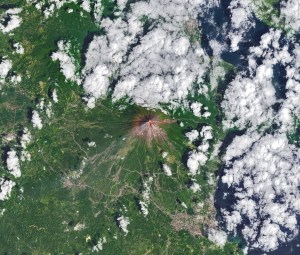


At any given moment, about 20 volcanoes on Earth are actively erupting. Often among them is Mayon—the most active volcano in the Philippines.
These X-ray computed tomography (XCT) scans of particles from asteroid Bennu show the most common types of crack networks observed in Bennu samples.
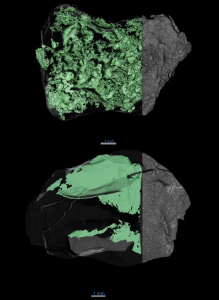
In one of the biggest surprises of NASA’s OSIRIS-REx mission, its target asteroid, Bennu, turned out to be a jagged, rugged world covered in large boulders, with few of the smooth patches of sandy or pebbly material scientists had expected based on observations with Earth-based instruments. Bennu’s looks were quite deceiving, and until now, scientists struggled to figure out why.
As four astronauts travel around the Moon on NASA’s Artemis II mission, they will venture beyond Earth’s protective magnetic field. The crew’s spacecraft, Orion, will carry and protect them as they journey into deep space and serves as the main protection against the Sun’s intense power. During their 10-day flight, NASA and the National Oceanic and Atmospheric Administration (NOAA) will monitor the
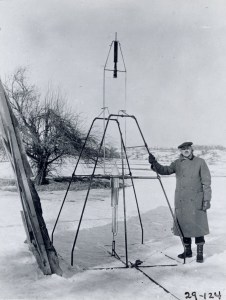
Dr. Robert H. Goddard and a liquid oxygen-gasoline rocket in the frame from which it was fired on March 16, 1926, at Auburn, Mass.
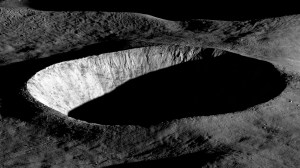
Early morning sunlight illuminates the western wall of this unnamed crater, leaving deep shadows on the ground and in the interior. The image was taken on August 30, 2023, by LROC (Lunar Reconnaissance Orbiter Camera).
A testing replica of the “backbone” of NASA’s James Webb Space Telescope and a full-scale model of the agency’s Parker Solar Probe are now on permanent display at the Smithsonian’s National Air and Space Museum, Steven F. Udvar-Hazy Center in Chantilly, Virginia.
The Graphics and Visualization Lab (GVIS) at NASA Glenn Research Center creates a variety of immersive visualizations and simulations in support of NASA’s missions, projects, and future innovations. These visual tools help scientists, engineers, and researchers develop new solutions that bring their projects to life. Virtual System Simulations The GVIS Lab prides itself on creating
The Graphics and Visualization Lab (GVIS) at NASA Glenn Research Center creates a variety of immersive visualizations and simulations in support of NASA’s missions, projects, and future innovations. These visual tools help scientists, engineers, and researchers develop new solutions that bring their projects to life. Conceptual Visual Designs GVIS creates conceptual visual designs for proposed
The Graphics and Visualization Lab (GVIS) at NASA Glenn Research Center creates a variety of immersive visualizations and simulations in support of NASA’s missions, projects, and future innovations. These visual tools help scientists, engineers, and researchers develop new solutions that bring their projects to life. Scientific Visualizations GVIS creates scientific visualizations to explain complex scientific
The Graphics and Visualization Lab (GVIS) at NASA Glenn Research Center creates a variety of immersive visualizations and simulations in support for NASA’s missions, projects, and future innovations. These visual tools help scientists, engineers, and researchers develop solutions to bring their projects to life. Test Facility Models GVIS creates visualizations of various NASA test facilities.
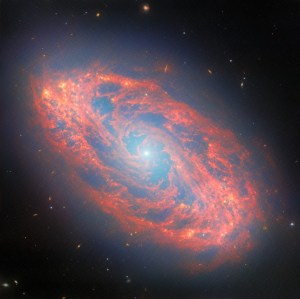
Two powerful instruments of the NASA/ESA/CSA James Webb Space Telescope joined forces to create this scenic galaxy view. This spiral galaxy is named NGC 5134, and it’s located 65 million light-years away in the constellation Virgo.
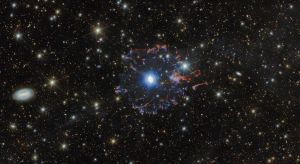
In Euclid’s wide, near-infrared, and visible light view, the arcs and filaments of the nebula’s bright central region are situated within a halo of colorful fragments of gas zooming away from the star. This ring was ejected from the star at an earlier stage, before the main nebula at the center formed. Hubble captures the very core of the billowing gas with high-resolution visible-light images, adding extra detail in the center of this image. The whole nebula stands out against a backdrop teeming with distant galaxies, demonstrating how local astrophysical beauty and the farthest reaches of the cosmos can be seen together in modern astronomical surveys. Together, these missions provide a rich and complementary view of NGC 6543 — revealing the delicate interplay between stellar end-of-life processes and the vast cosmic tapestry beyond.
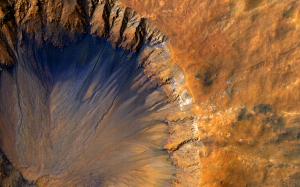
This impact crater, as seen by NASA's Mars Reconnaissance Orbiter in 2015, appeared relatively recent as it has a sharp rim and well-preserved ejecta.
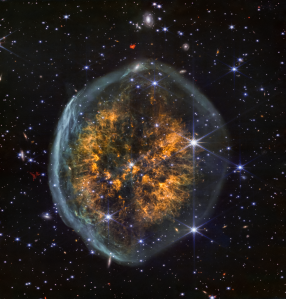
A brain-new image from Webb! What looks like a brain (complete with what appear as left and right hemispheres) is actually a dying star blowing off a shell of gas, and within that shell, a cloud of various gases.
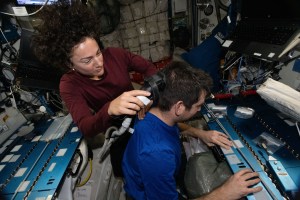
Weekends on the International Space Station are for housecleaning and haircuts. NASA astronaut Jessica Meir trims the hair of fellow NASA astronaut Jack Hathaway, both Expedition 74 flight engineers, using an electric razor attached to a vacuum that collects loose clippings to keep the station’s atmosphere clean in microgravity.
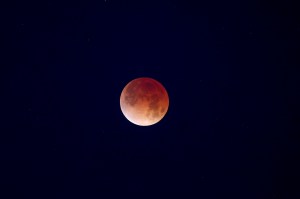
A total lunar eclipse rises over New Orleans, home of NASA’s Michoud Assembly Facility, in the early morning hours of Tuesday, March 3. A lunar eclipse occurs when Earth passes directly between the Sun and Moon, casting a huge shadow across the Moon’s surface. The Moon appears dark red or orange as the Sun’s light filters through Earth’s atmosphere.
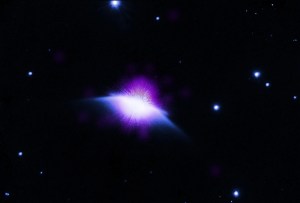
For the first time, a much younger version of the Sun has been caught red-handed blowing bubbles in the galaxy, by astronomers using NASA’s Chandra X-ray Observatory.
In a first, a space mission led by NASA and France has tracked Earth’s rivers swelling and shrinking from month to month over the course of a year and found significantly less of a swing than previous model-based estimates. A record drought in the Amazon likely influenced the tally made by the Surface Water and
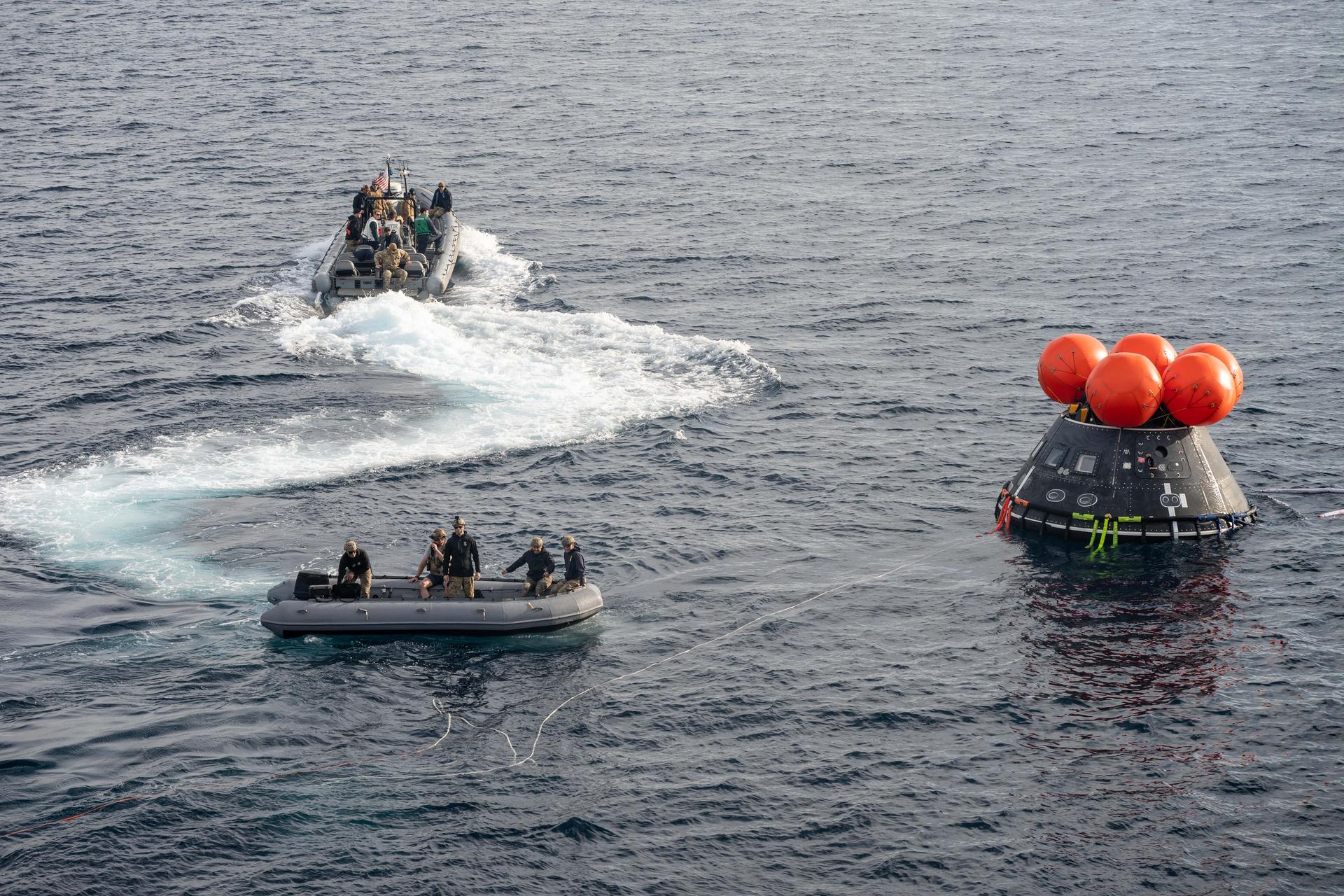
Off the coast of California, NASA’s Artemis Landing and Recovery team and the Department of War that will work together to retrieve the Artemis II crew and Orion spacecraft following their return to Earth and splashdown in the Pacific Ocean are performing a final simulation of their activities, called a just-in-time training, at sea on Tuesday, Jan. 27, 2026. During the training, teams use the Crew Module Test Article, a full-scale mockup of the Orion spacecraft, to simulate as close as possible the conditions they can expect to encounter during splashdown of the Artemis II mission.
 ×
×
×
×
×
×
×
×