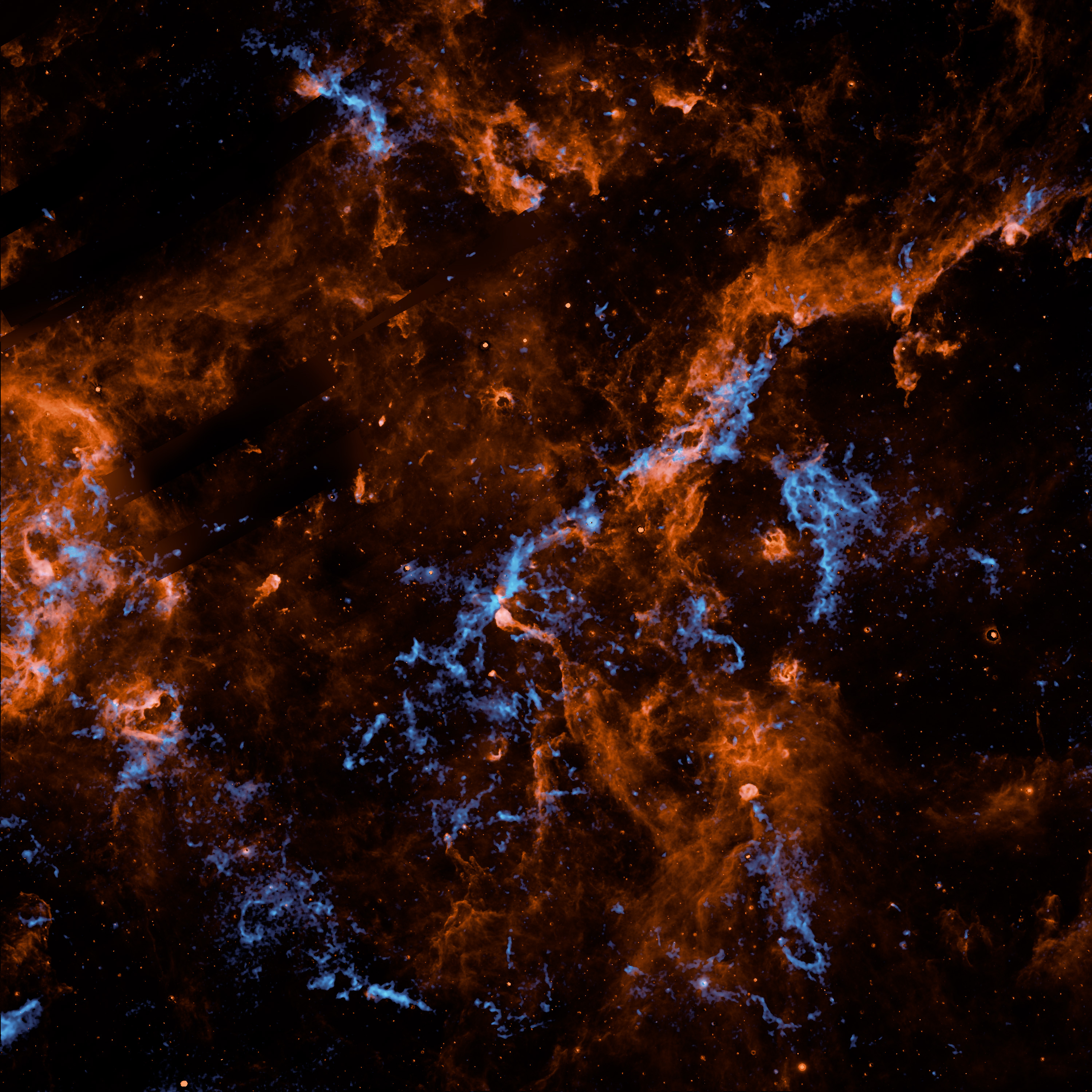
An observation made by NASA’s SPHEREx mission reveals vast frozen complexes in the Cygnus X star-forming region of the Milky Way galaxy. The chemical signature of water ice is shown as bright blue structures, while polycyclic aromatic hydrocarbons are in orange.
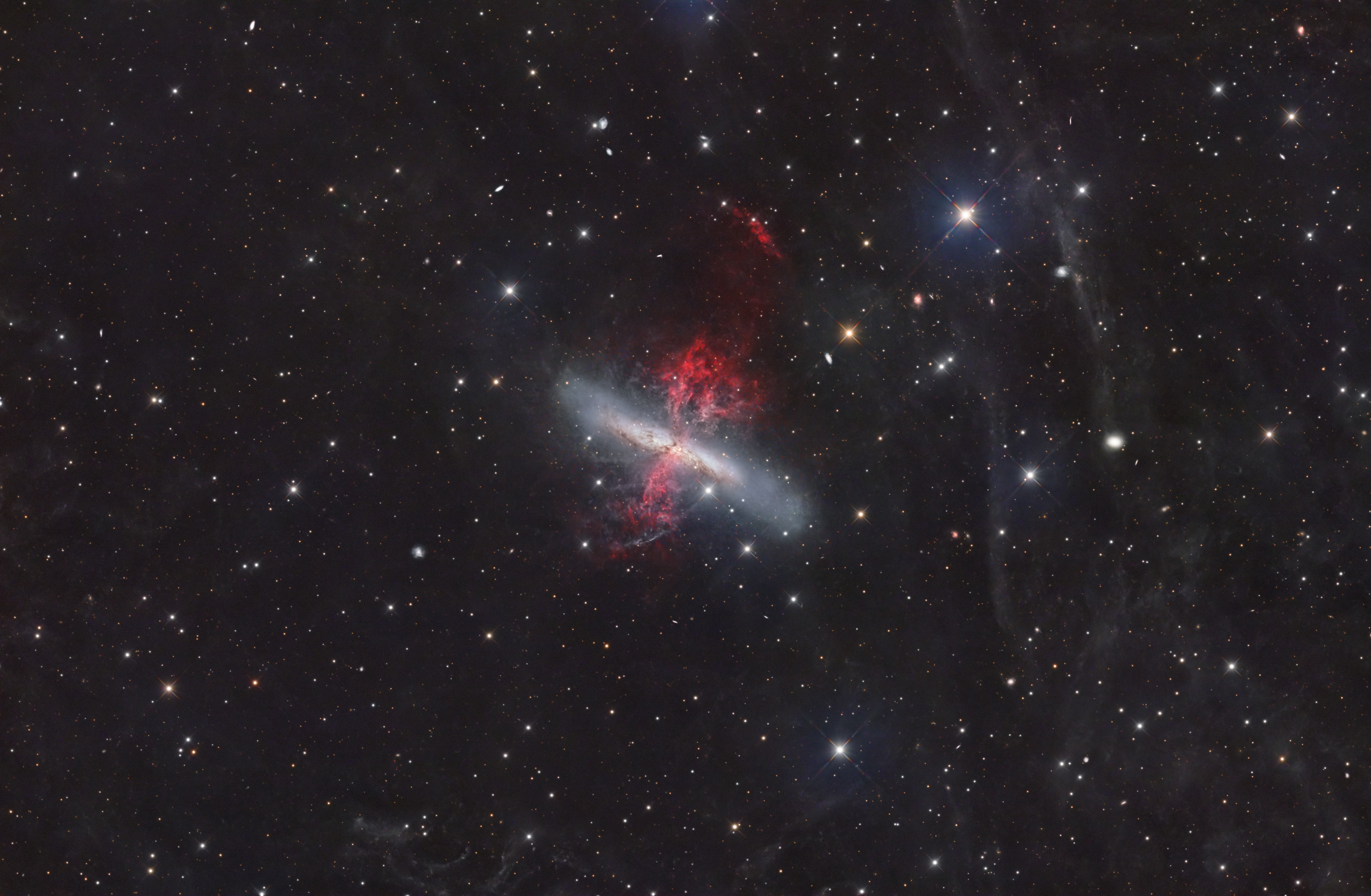
Messier 82 is a starburst galaxy with a superwind. In fact, through supernova explosions and powerful winds from massive stars, the burst of star formation in M82 is driving a prodigious outflow. Evidence for the superwind from the galaxy's central regions is clear in the sharp telescopic portrait. The composite image includes 33 hours of narrowband data, highlighting emission from long outflow filaments of atomic hydrogen gas in reddish hues. Some of the gas in the superwind, enriched in heavy elements forged in the massive stars, will eventually escape into intergalactic space. Triggered by a close encounter with nearby large galaxy M81, the furious burst of star formation in M82 should last about 100 million years or so. Also known as the Cigar Galaxy for its elongated visual appearance, M82 is about 30,000 light-years across. It lies 12 million light-years away near the northern boundary of Ursa Major.
Live now • 764 watching • NASA’s mobile launcher is on the move as teams prepare for the upcoming Artemis III mission. The massive structure will begin to roll back atop the crawler transporter to the Vehicle Assembly...
Live now • 21,701 watching • Live from NASA's Johnson Space Center in Houston, join the astronauts of Artemis II as they discuss their mission around the Moon. NASA astronauts Reid Wiseman, Victor Glover, Christina Koch,...
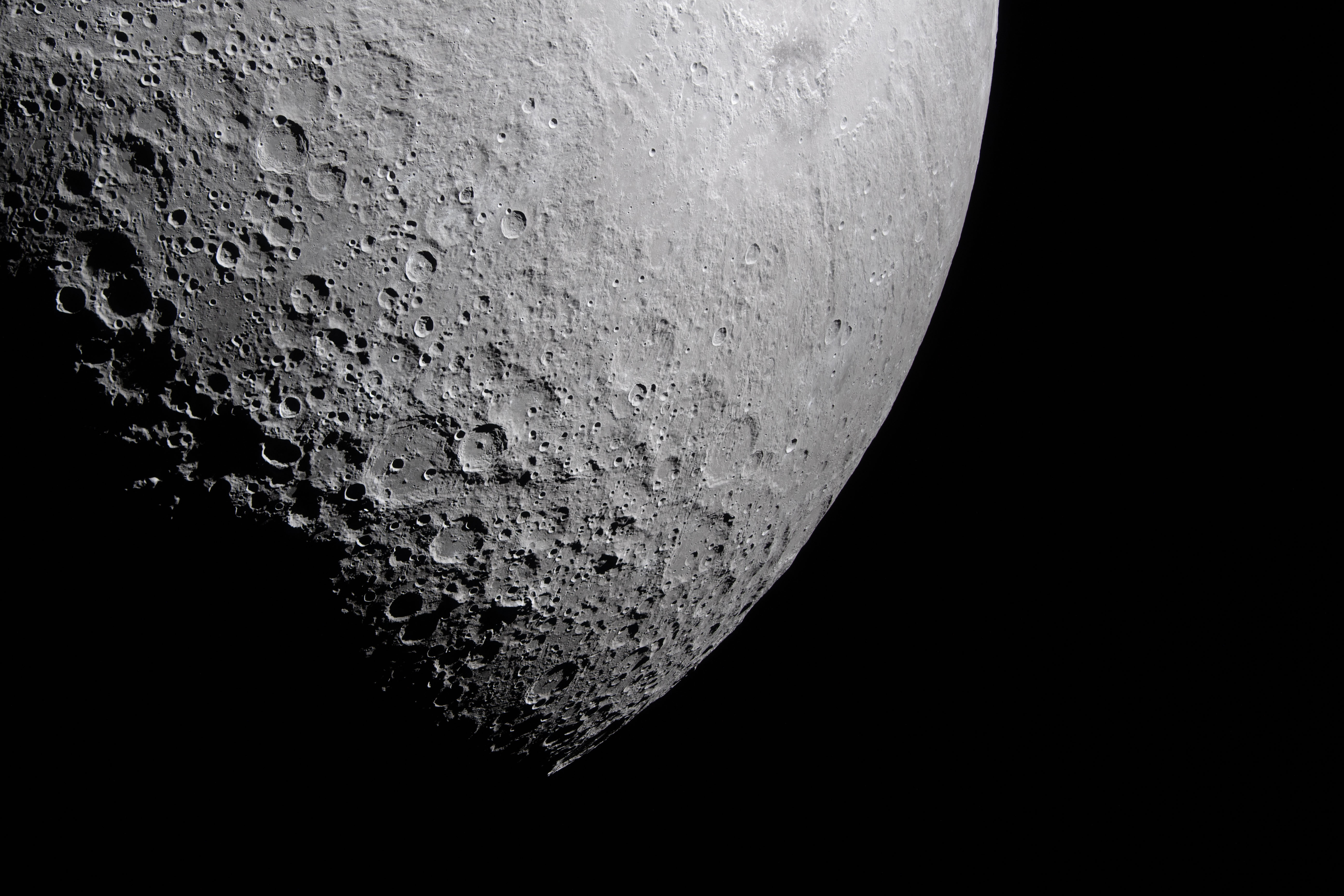
A portion of the Moon’s far side is seen along the terminator—the boundary between lunar day and night—where low-angle sunlight casts long shadows across the surface.
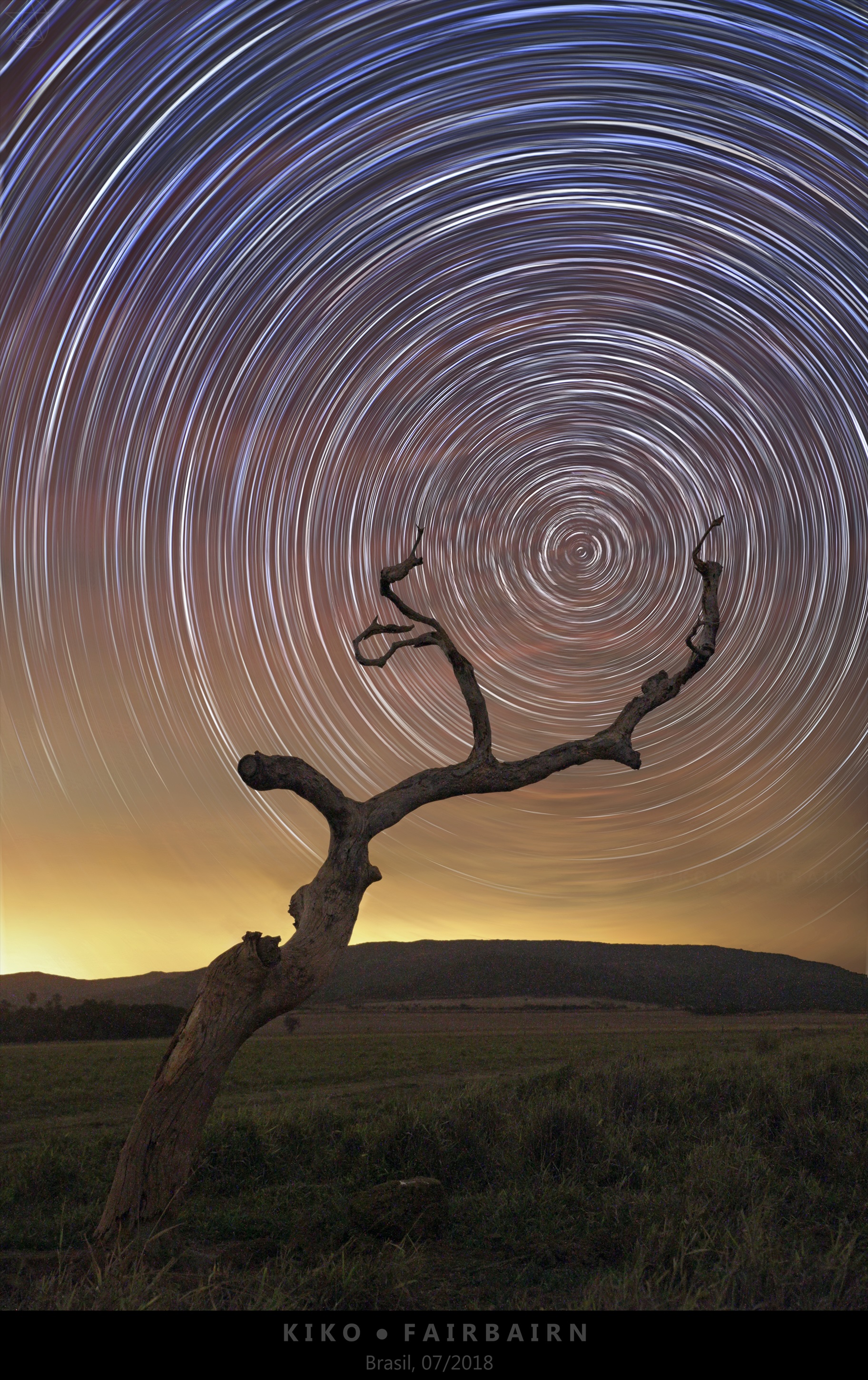
If you live in the northern hemisphere, you may have learned how to locate the North Star, Polaris, in the night sky. It can be used to find north, and it approximately marks the northern celestial pole. If you live in the southern hemisphere, there is no bright star marking the southern celestial pole, but the Southern Cross can be used to find south. The featured image was taken in Padre Bernardo (GO), Brazil. It shows the apparent motion of the stars around the apparently empty southern celestial pole over 2 hours, on August 20, 2018. Each star takes about 24 hours to make a complete turn around the pole in the sky. Padre Bernardo is located in the Cerrado region, a tropical savanna that occupies most of central Brazil and supports rich biodiversity. The barren branch that apparently supports this sky wheel of rotating stars is a common sight there in the dry season during the southern winter.
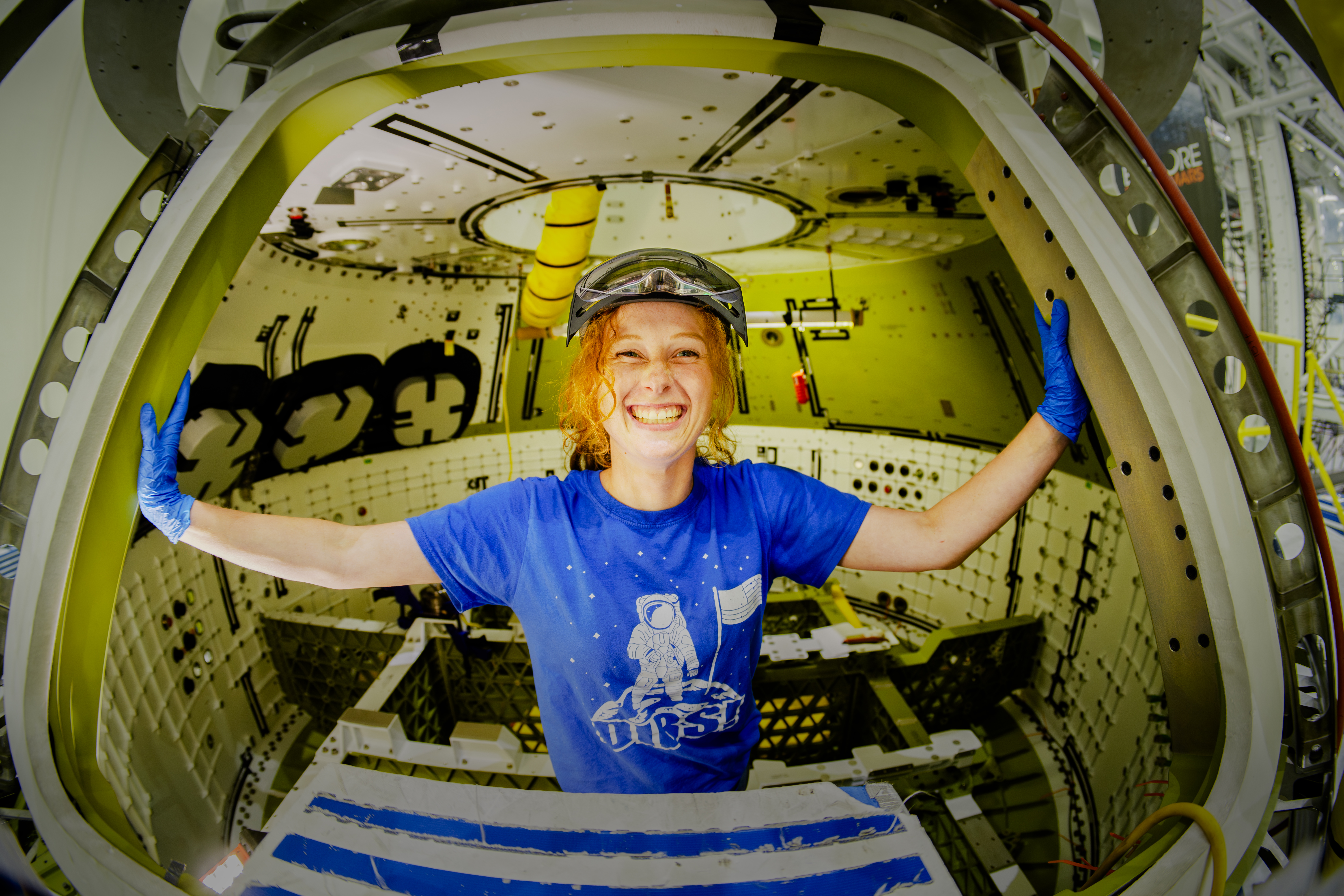
Listen to this audio excerpt from Rebekah Tolatovicz, a mechanical technician lead supporting the Orion spacecraft’s main contractor Lockheed Martin: At NASA’s Kennedy Space Center in Florida, there is a fleet of Orion spacecraft in work, and Rebekah Tolatovicz’s hands have helped build each one. Tolatovicz works to build, integrate, and test the spacecraft used
NASA’s Artemis II crew shared brief remarks with friends, family, and colleagues after they landed at Ellington Airport near NASA’s Johnson Space Center in Houston on Saturday, April 11, 2026, after a nearly 10-day journey around the Moon and back to Earth.
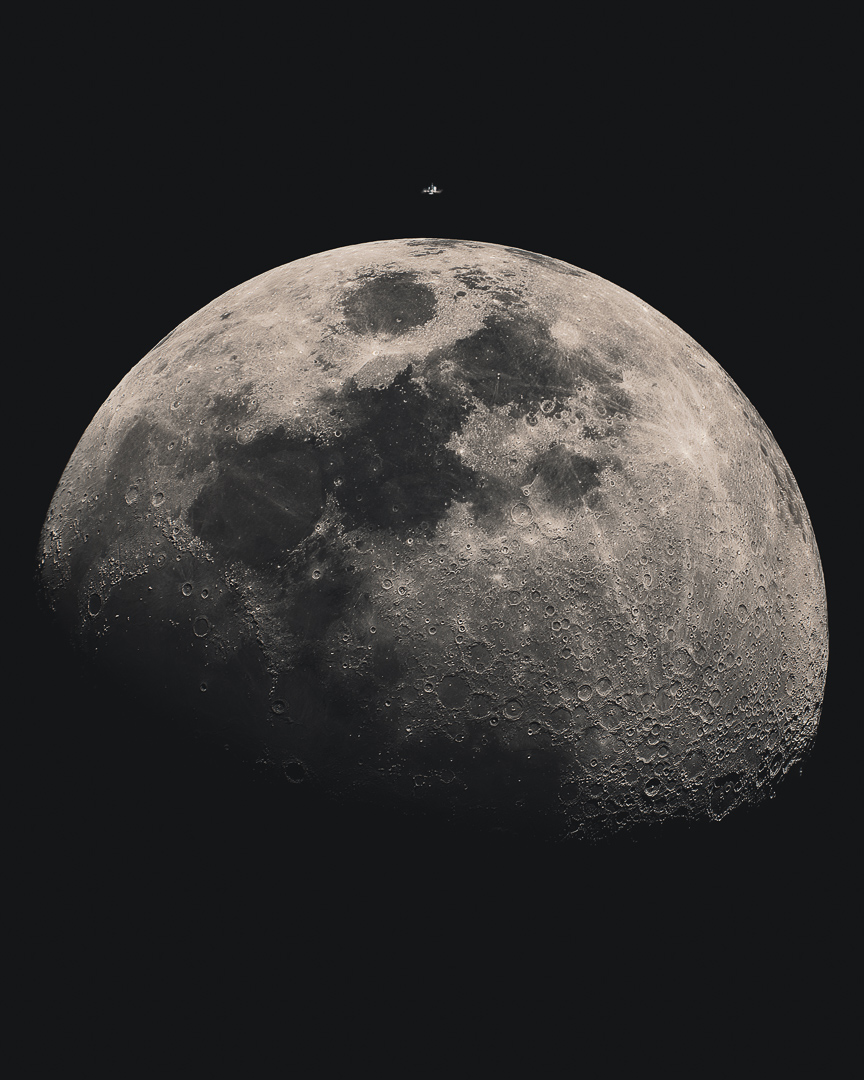
Nope, that is not an alien spaceship landing on the Moon! This is an image of the International Space Station (ISS) as it begins to transit in front of the Moon. The ISS is in low-Earth orbit (LEO) where it wizzes around the Earth every 90 minutes. Orbiting the Earth 16 times per day for 25 years, the ISS has photobombed many familiar celestial objects including Venus, Mars, Saturn, and the Sun. Thousands of experiments led by researchers from over one hundred countries have been conducted on the ISS. Growing protein crystals in low gravity was one of the first experiments onboard the ISS and continues to contribute to new medical treatments. ISS astronauts study plant growth, water recycling, human health, and more to support the Artemis missions which will take humans farther than they’ve ever gone before. Next time you are out and about at night, try to spot the ISS zooming across the sky!
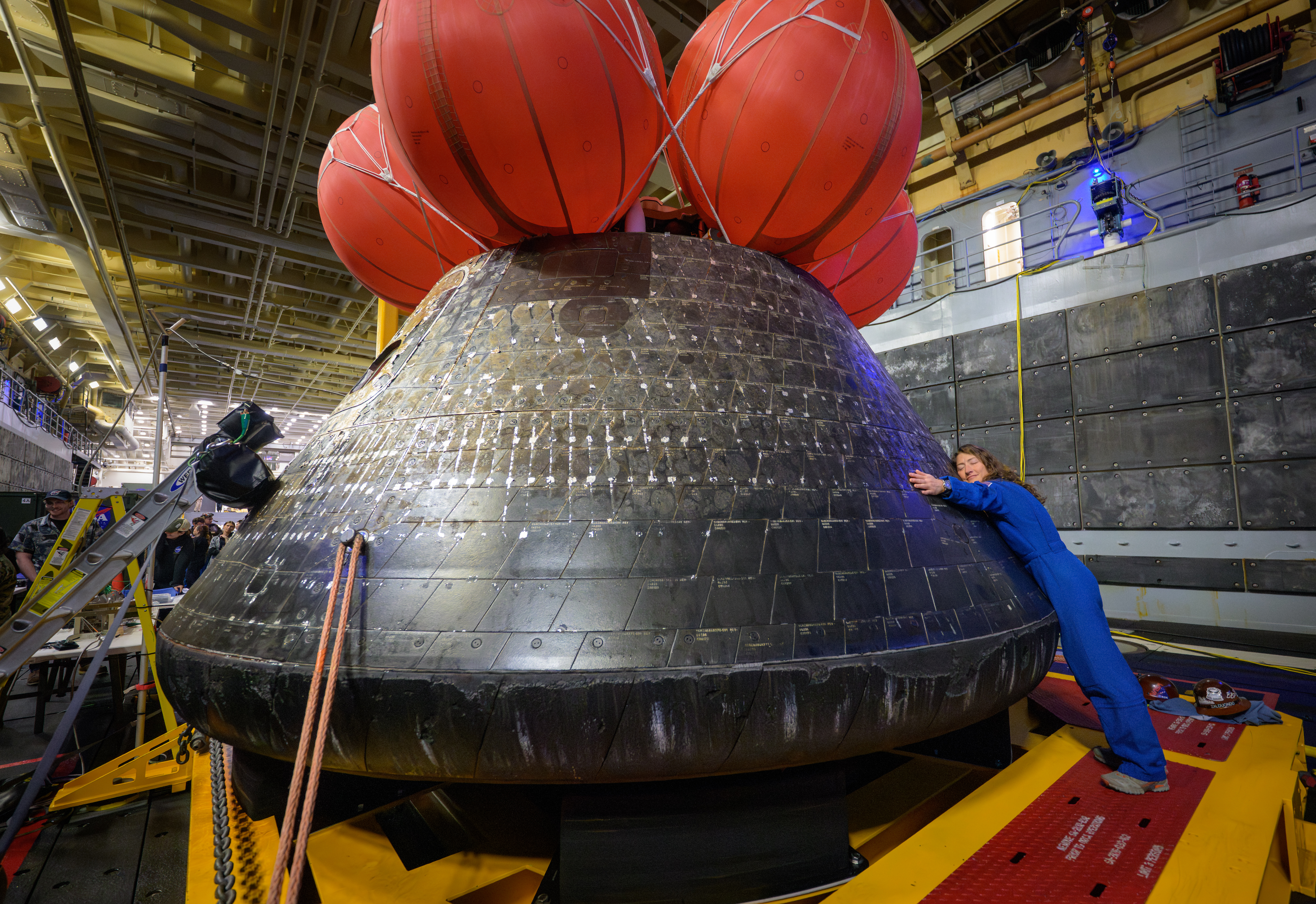
NASA astronaut Christina Koch, Artemis II mission specialist hugs the Orion spacecraft in the well deck of USS John P. Murtha, Saturday, April 11, 2026.
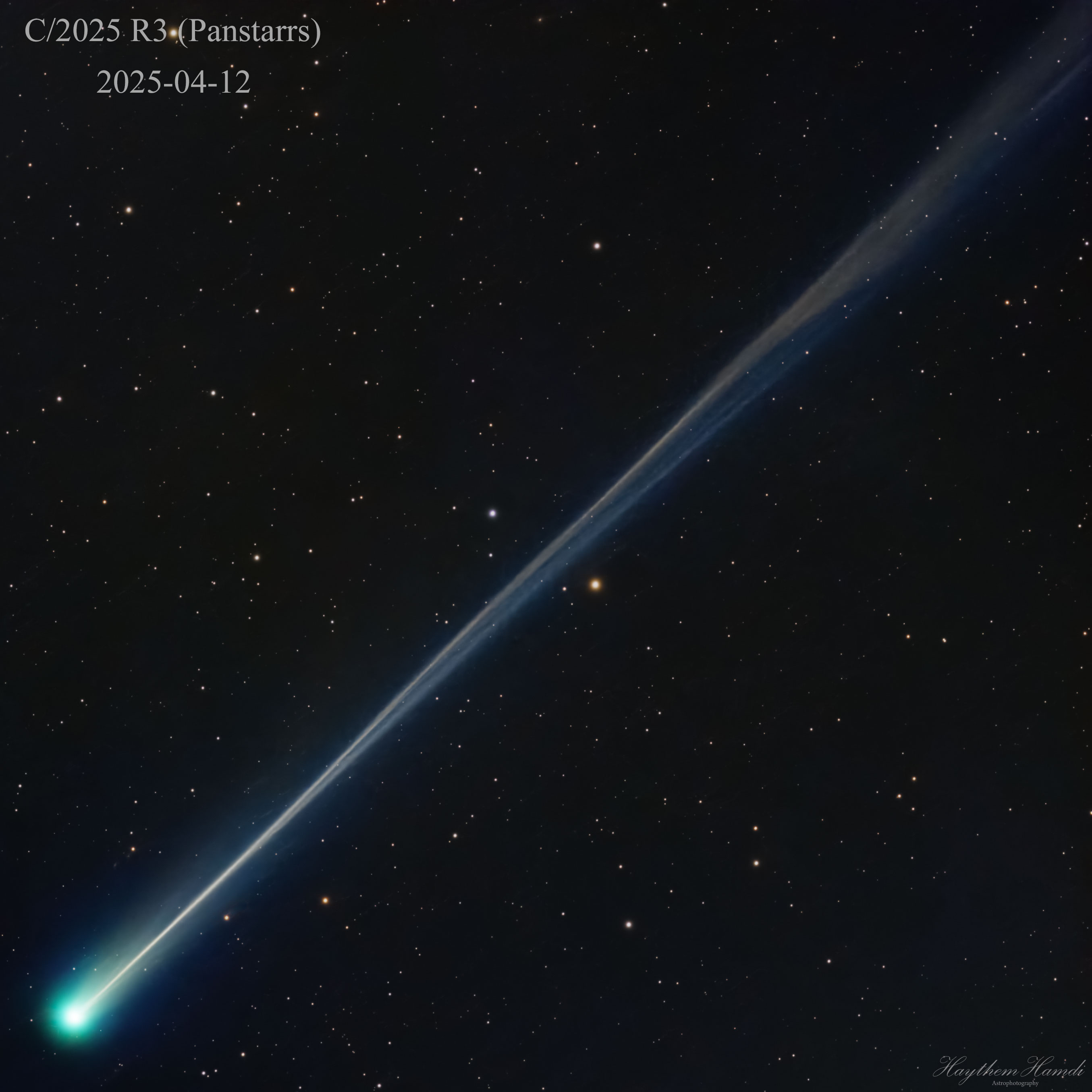
Why does Comet R3 (PanSTARRS) have a wispy tail? The newest bright member of the inner Solar System, Comet C/2025 R3 (PanSTARRS) is already extending an impressive stream of glowing gas. This tail starts from an unseen central nucleus of dirty ice that is likely a few kilometers across. The nucleus is warmed by the Sun and emits a cloud of neutral gas into a coma that glows light green. Nuclear gas ionized by energetic sunlight is pushed away from the Sun by the solar wind into an ion tail that glows light blue. The wispy nature of the ion tail is caused by the constantly changing structure of the solar wind. Pictured from Rhode Island, USA two days ago, Comet R3 (PanSTARRS) shows off a many-degree ion tail. Comet R3 (PanSTARRS) is best seen before dawn from northern skies for another 10 days, after which it will be best visible from southern skies. Growing Gallery: Comet R3 in 2026
NASA’s 32nd annual Human Exploration Rover Challenge, one of the agency’s longest-standing student challenges, culminated April 10-11 with its final excursion event at the U.S. Space & Rocket Center near NASA’s Marshall Space Flight Center in Huntsville, Alabama. Spanning nine months, the challenge tasks student teams from around the world to design, build, and test
NASA astronauts Reid Wiseman, commander; left, Christina Koch, mission specialist; CSA (Canadian Space Agency) astronaut Jeremy Hansen, mission specialist; and NASA astronaut Victor Glover, Artemis II pilot, right, pose for a group photo after viewing the Orion spacecraft in the well deck of USS John P. Murtha, Saturday, April 11, 2026, in the Pacific Ocean off the coast of California. The quartet splashed down Friday, April 10 at 5:07 p.m. PDT (8:07p.m. EDT).
Live now • 5,834 watching • Northrop Grumman’s Cygnus XL cargo spacecraft arrives at the International Space Station, delivering supplies, new research, and a module to advance quantum science. Astronauts aboard the...
New nighttime maps based on NASA satellite imagery are upending assumptions, revealing a world where artificial brightening and dimming have intensified over the past decade. The findings show intense flaring over major oil and gas fields in the United States, while factors such as rural electrification and energy conservation are changing how billions around the
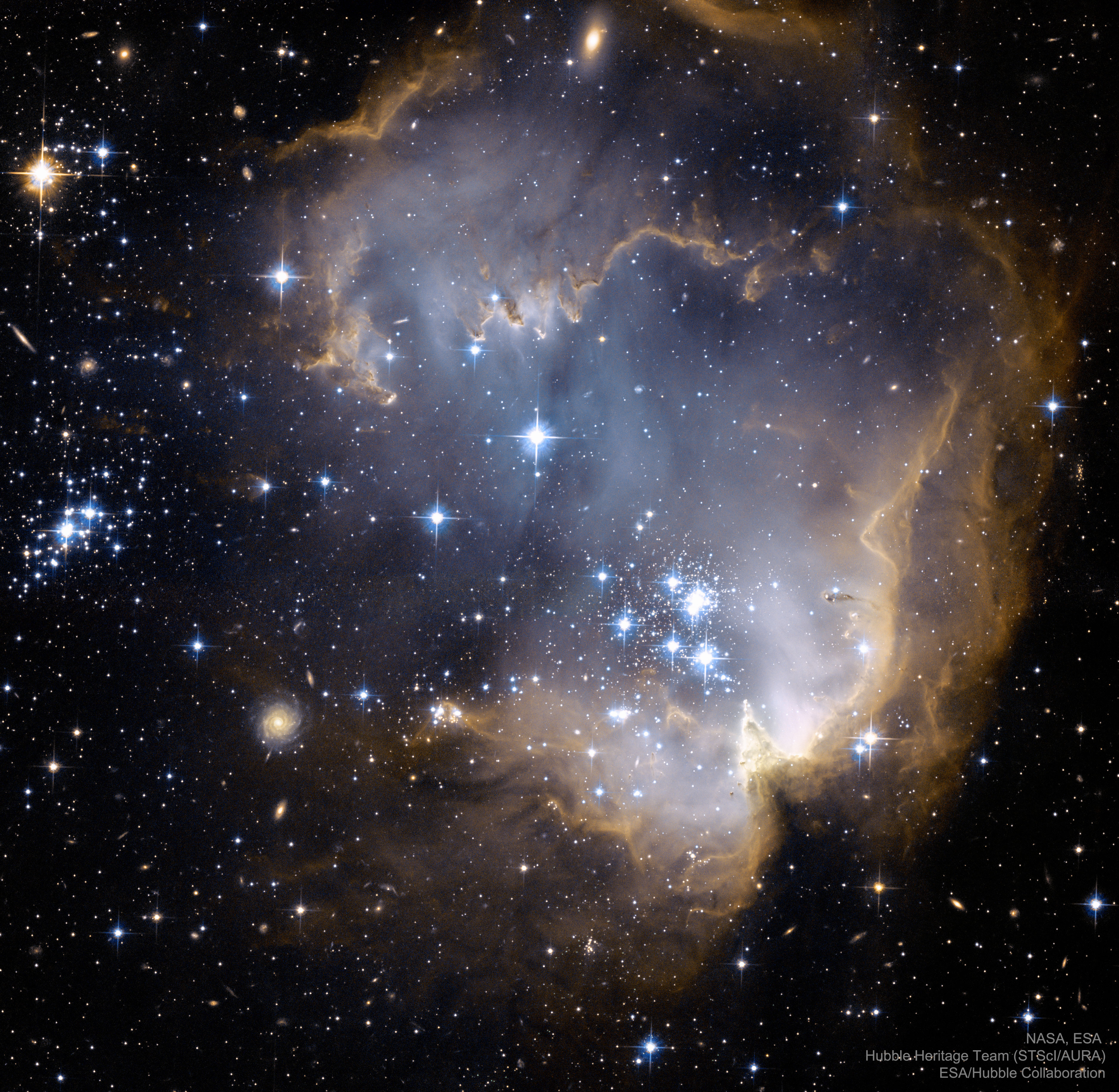
The clouds may look like an oyster, and the stars like pearls, but look beyond. Near the outskirts of the Small Magellanic Cloud, a satellite galaxy some 200 thousand light-years distant, lies 5 million year young star cluster NGC 602. Surrounded by natal gas and dust, NGC 602 is featured in this stunning Hubble image of the region. Fantastic ridges and swept back shapes strongly suggest that energetic radiation and shock waves from NGC 602's massive young stars have eroded the dusty material and triggered a progression of star formation moving away from the cluster's center. At the estimated distance of the Small Magellanic Cloud, the featured picture spans about 200 light-years, but a tantalizing assortment of background galaxies are also visible in this sharp multi-colored view. The background galaxies are hundreds of millions of light-years or more beyond NGC 602. Sky Surprise: What picture did APOD feature on your birthday? (after 1995)
Our Artemis II Moon mission is complete! Space Launch System rocket launched crew into space Orion spacecraft provided a safe “home away from home” for astronauts Flew around the Moon, observed its far side, and conducted science New human spaceflight distance record Crew safely returned to Earth Inspired the WORLD We're just getting started: https://www.nasa.gov/mission/artemis-iii/
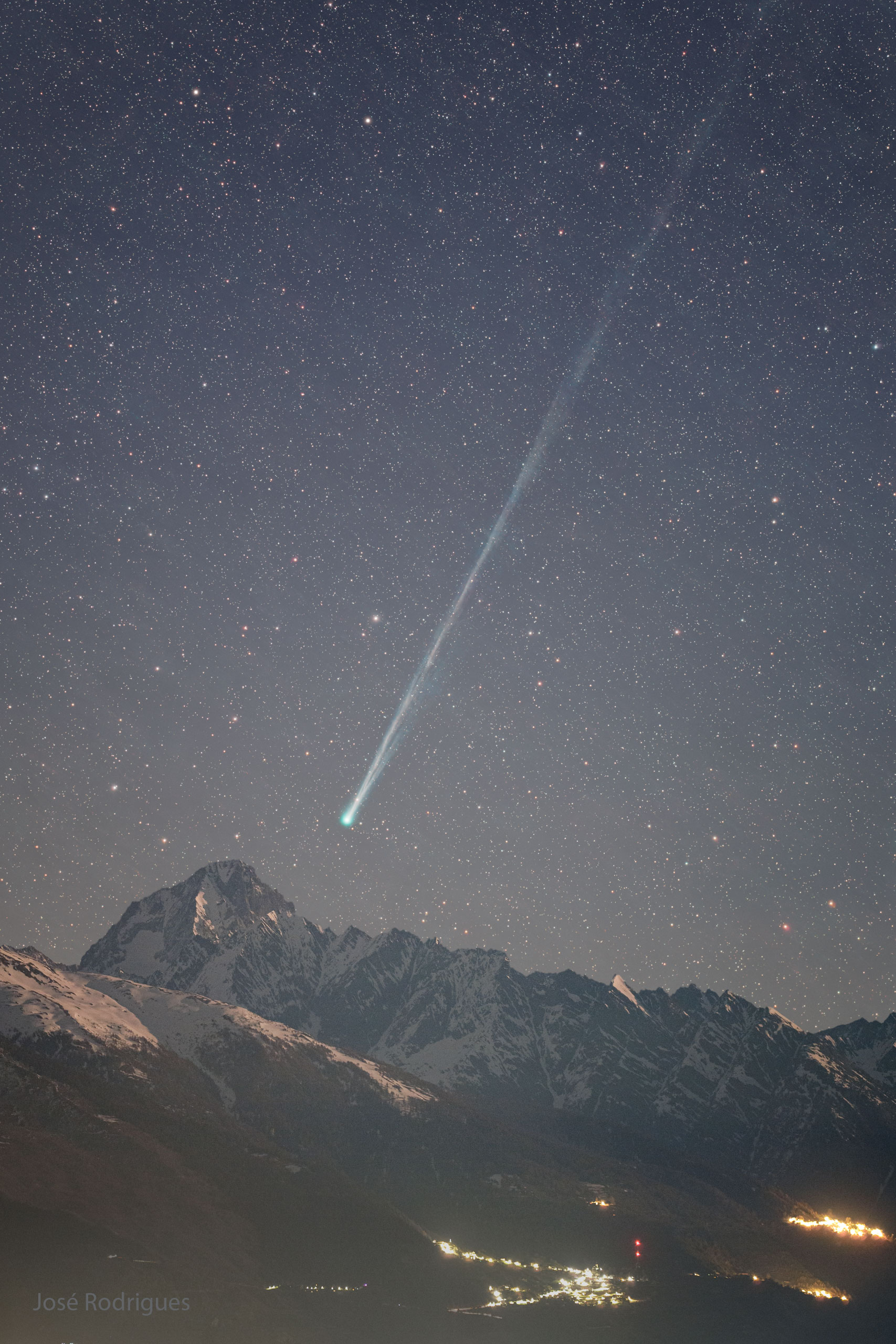
Comet R3 is brightening rapidly -- will it survive? C/2025 R3 (PanSTARRS) has been slowly brightening and extending an ion tail since its discovery last year. This shedding mountain of dirty ice puts on its best sky show this month, though, because it passes its closest to both the Sun (April 19) and the Earth (April 25). The featured image, showing R3 already sporting a tail extending over 10 degrees, was taken two nights ago from Sion, Switzerland with the big mountain Bietschhorn on the left. Comet R3 will be visible during mid-April before sunrise. Although the future brightness of any comet is hard to predict, the brightness of R3 makes it already a good camera comet and it may become visible to the unaided eye in the next week. Comet R3's physical future is also unknown because, like Comet A1 (MAPS) earlier this month, it may disintegrate when it passes its closest to the Sun. Or it may live to leave the Solar System. Growing Gallery: Comet R3 in 2026
Live now • 103,187 watching • After their historic journey around the Moon, the Artemis II astronauts are coming home. Watch as they arrive in Houston, Texas, home to NASA's Johnson Space Center. NASA astronauts Reid Wiseman,...
Live now • 4,048 watching • Watch the launch of a cargo spacecraft to the International Space Station, delivering supplies, new research, and a module to advance quantum science. Northrop Grumman's uncrewed Cygnus XL...